
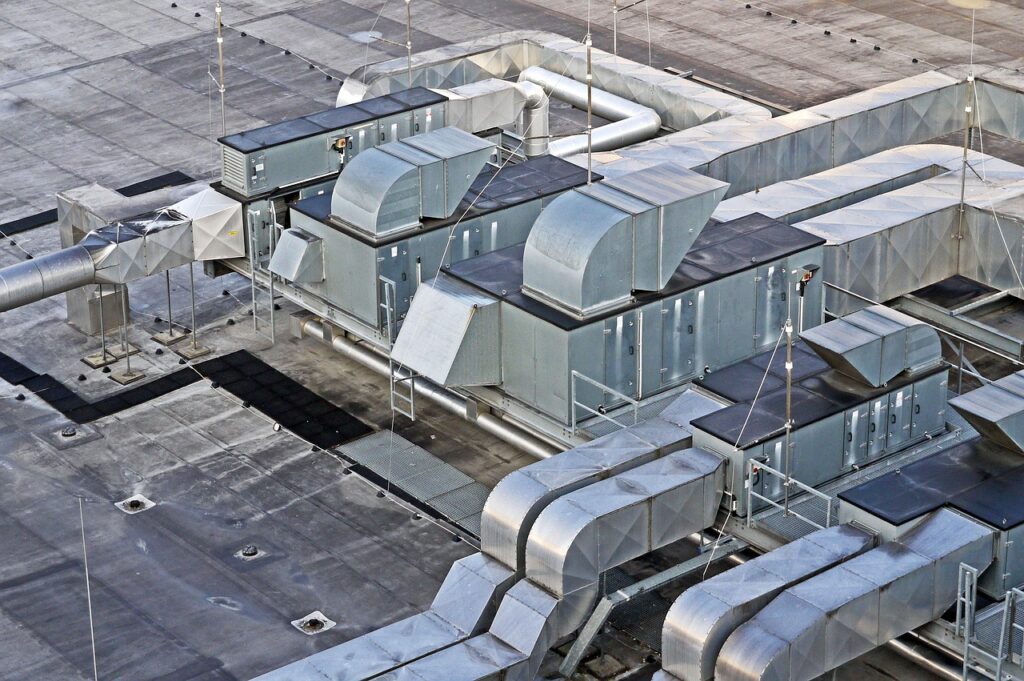
Industrial ventilation is the invisible backbone of modern manufacturing facilities. Whether you are designing a complex dust collection network, a material conveying system, or an industrial HVAC setup, moving air efficiently is critical. When these systems underperform, the entire production environment is compromised.
In this guide, we will explore the core principles of industrial ventilation and explain why calculating the exact air duct velocity is the most important step in optimizing your aerodynamic systems.
Why Air Duct Flow Velocity Matters
A common mistake in mechanical design is focusing entirely on the volume flow rate (m³/h) and the fan size, while neglecting the speed of the air traveling through the ducts. However, air velocity (m/s) dictates how the system behaves in reality.
If the duct diameter is incorrectly sized for the required airflow, you will inevitably face one of two catastrophic system failures:
If ducts are oversized, the air speed drops. In dust collection systems, particulate matter drops out of the airstream and settles inside the ductwork. This reduces the effective cross-sectional area, increases fire risks, and eventually chokes the entire system.
If ducts are undersized, the air speed skyrockets. Friction losses increase exponentially, leading to severe pressure drops. High velocity also causes excessive noise, wastes fan energy, and accelerates the abrasion of duct walls.
Manually calculating volume flow rates (m³/h), velocities (m/s), and cross-sectional areas is prone to errors. We developed a free, instant tool for mechanical designers to optimize their ductwork mathematically.
Use the Air Duct Velocity CalculatorBest Practices for Duct Sizing
To achieve a perfectly balanced industrial ventilation system, follow these standard engineering practices:
- Identify the Target Velocity: Different materials require different conveying velocities. For example, light wood dust might need 18-20 m/s to stay suspended, while heavy metal grinding dust requires 22-25 m/s. Clean air HVAC systems typically operate at much lower velocities (5-10 m/s) to minimize noise.
- Calculate Cross-Sectional Area: Once you know your target velocity and the required volume flow rate, calculate the exact duct diameter needed. Use our Air Duct Velocity Calculator to instantly find the correct dimensions without manual formula manipulation.
- Minimize Friction: Avoid sharp 90-degree elbows and abrupt diameter changes. Smooth transitions and long-radius bends maintain velocity consistency and reduce static pressure losses.
Industrial ventilation requires mathematical precision. By verifying your duct velocities before manufacturing begins, you can ensure system reliability, reduce fan energy consumption, and extend the lifespan of your mechanical equipment.
Explore our full suite of engineering tools and CAD automation macros at Cadgate to streamline your mechanical design workflows.